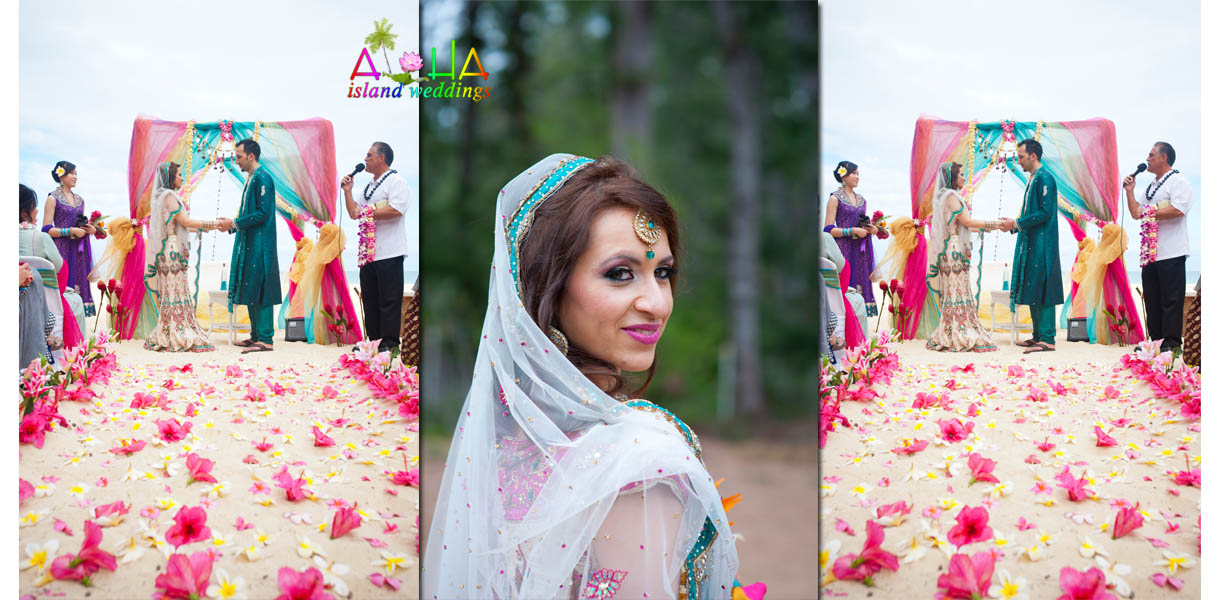
The Indian Wedding Dress
An Indian wedding is nothing short of a glorious fashion show, above all when you look at the bride, who may change her attire several times over the course of the celebrations. Beside her, the groom’s clothes often seem simple, though in many regions they are every bit as splendid.
The Bridal Sari
The sari is a single length of cloth, about six yards long and in some South Indian traditions nine, wrapped around the body in an intricate drape over a fitted blouse called a choli. Pleats cascade from the waist in front, one end is tucked in firmly, and the other end, the pallu, is draped over the shoulder or, in some regions, over the head as a veil.
A bridal sari is almost always woven of rich silk shot with gold or silver. It has three areas for decoration: the border, the body and the lavishly embellished pallu. The zari work on the border and pallu is exquisite and intricate, most often in silver thread, with gold embroidery reserved for the most precious saris. North Indian brides favor elegant Benarasi silks from Varanasi, while South Indian brides often choose the bright, heavy silks of Kanchipuram (Kanjivaram) or Dharmavaram.
Indian Bridal Dress at a Glance
- Sari: six to nine yards of silk with a choli blouse and an ornate pallu
- Silks: Benarasi in the north, Kanjivaram and Dharmavaram in the south
- Salwar kameez: tunic, trousers and dupatta, favored by Punjabi, Kashmiri and many Muslim brides
- Lehenga: a full embroidered skirt, choli and dupatta, popular across North India
- Colors: red, maroon, magenta and gold, with deep yellow and green also loved
Salwar Kameez and Lehenga
While the sari and choli are the most common bridal attire, the salwar kameez is preferred by many Punjabi, Kashmiri and Muslim brides. The salwar, loose pleated trousers, is worn beneath the kameez, a long tunic with side slits below the waist for ease of movement. Both are made of silk, often woven with silver flowers, and completed by a dupatta, a light shawl shimmering with zari, worn over the head on the wedding day. Many North Indian brides also choose the lehenga, a full embroidered skirt worn with a choli and dupatta.
Changing Saris
In many traditions the bride changes saris to mark significant moments: once after kanyadaan, when her parents give her hand to the groom, and again before the reception hosted by the groom’s family, who often present her with these saris. The bride and her closest attendant shop for them together, and saris are exchanged between the families as a mark of honor.

The Groom: Sherwani, Pheta and Mojdi
North Indian grooms wear a sherwani, a closed-collar coat that falls to the knee, over fitted churidar trousers, with a dupatta draped from the neck. Wedding sherwanis are silk, embroidered all over or along the front, collar and cuffs, often in red, maroon or ivory to set off the zari. The look is completed by a pheta, the wedding turban, and embroidered mojdi shoes with curled toes. Once, attendants wound six to nine yards of silk around the groom’s head; today ready-tied phetas are common, in Rajasthani, Punjabi and Mysore styles that reveal the groom’s roots.
In South India the groom’s attire is beautifully simple: a silk dhoti, two or three yards of white cloth wrapped and pleated at the waist, worn with a kurta or an angavastram shawl and plain leather sandals. Tradition often calls for pure white or cream silk, edged with a fine gold border.
Explore more of our Indian wedding guides: Indian Wedding Themes · Bridal & Groom Dress · Choosing Saris · Wedding Customs · Pre-Wedding Ceremonies · Wedding Cards