Indian Wedding Customs
Every wedding creates a small new world, whatever the culture. In an Indian wedding, the customs exist to bind the couple to each other’s well-being in every part of life, and to weave two families into one. Beneath all the color and music lies a ceremony of deep and beautiful promises.
Kanyadaan
In many Hindu weddings the sacred rites begin with kanyadaan, when the bride’s parents give her hand to the groom, often pouring holy water over the couple’s joined hands. In some communities this is preceded by other rites; for many Brahmin families, the groom’s upanayana, the sacred thread ceremony, marks his readiness for the responsibilities of family life. Kanyadaan signifies that the bride now begins a new life as a member of her husband’s family.
A Promise of Partnership
At the heart of the ceremony is the groom’s promise to accept the bride as his equal partner in every part of life. With the words “dharme cha, arthe cha, kame cha,” he vows to share with her his duty, his prosperity and his joys, honoring her as his sahadharmini, his partner in righteousness.
The Heart of the Ceremony
- Kanyadaan: the bride’s parents give her hand to the groom
- Jaimala: the couple exchange flower garlands
- Mangalsutra: a sacred necklace of gold and black beads tied by the groom
- Sindoor: vermilion placed in the parting of the bride’s hair
- Saptapadi: seven steps around the sacred fire, each with its own vow
Garlands and the Mangalsutra
After kanyadaan the couple exchange garlands of flowers, and the groom ties the mangalsutra around the bride’s neck: a necklace of gold and black beads with one or two traditional pendants. It is the sign of a married woman in much of India, worn with pride as a symbol of the groom’s lifelong promise of love and protection. In many regions he also places sindoor, red vermilion, in the parting of her hair.
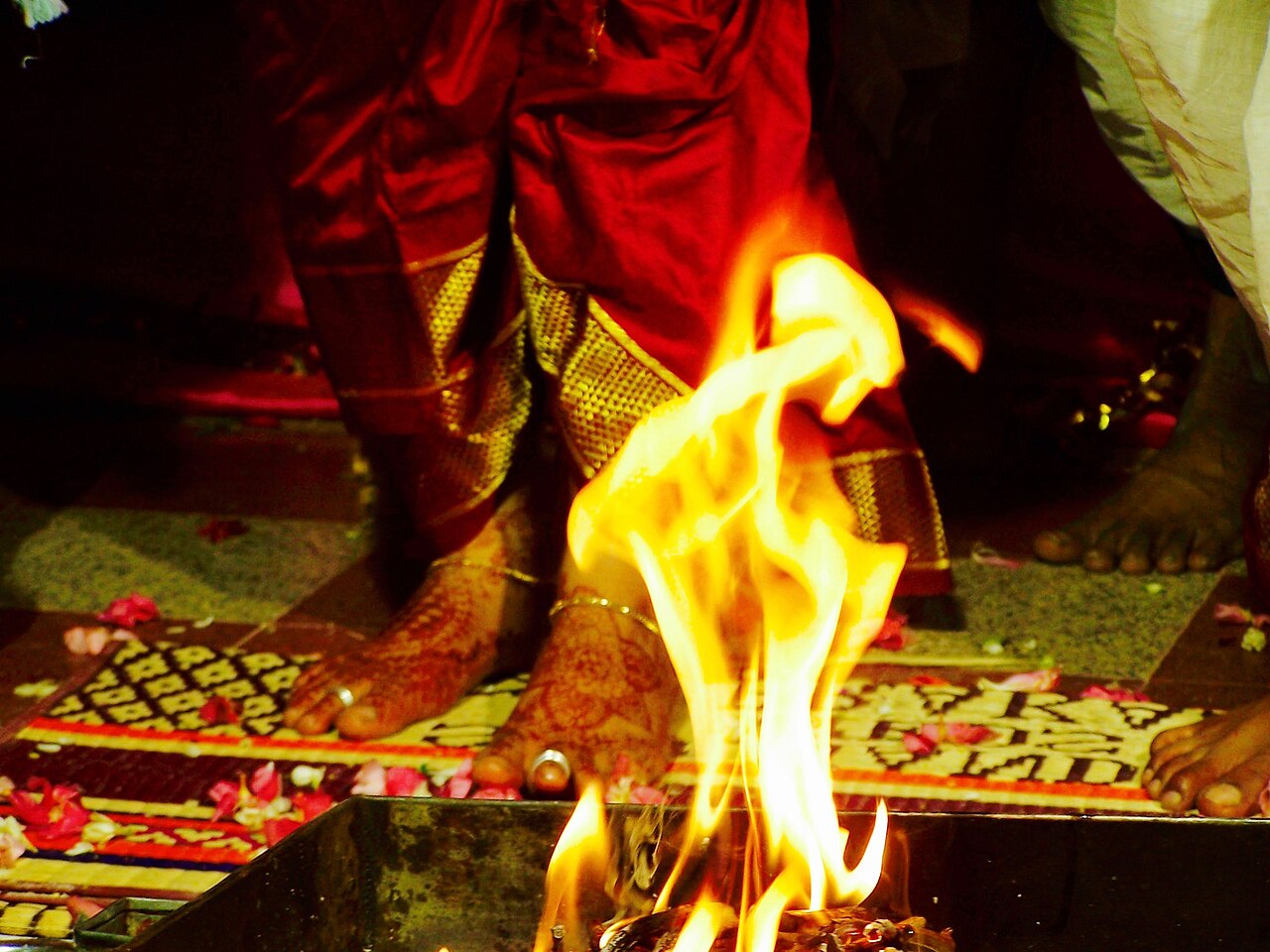
Saptapadi: Seven Steps Together
The final and most binding rite is the saptapadi, “seven steps.” The couple walk around the sacred fire, Agni, the eternal witness, and with each step make a vow: for nourishment, strength, prosperity, happiness, children, harmony through the seasons, and lifelong friendship. Once the seventh step is taken, they are married.
Customs differ among India’s many communities, and Sikh, Muslim, Christian and Parsi weddings each have their own beautiful rites, but the spirit of promise, family and celebration runs through them all.
Explore more of our Indian wedding guides: Indian Wedding Themes · Bridal & Groom Dress · Choosing Saris · Wedding Customs · Pre-Wedding Ceremonies · Wedding Cards
