A Jewish Wedding
A Jewish wedding is a ceremony of joy, promise and memory, rich with rituals passed from generation to generation across every land where Jewish families have lived. Customs vary from liberal to Orthodox communities and from one country to another, yet the heart of the celebration remains the same: two people building a new home, blessed by family and community.
Before the Wedding
The aufruf. On the Sabbath before the wedding it is customary to honor the groom, and in many communities the couple together, by calling them up to the Torah. The rejoicing begins with a kiddush reception after services.
The bride’s Sabbath. The bride may be honored at a women’s gathering where friends share stories and blessings for her marriage.
The mikveh. Before the wedding many brides, and some grooms, immerse in the mikveh, the ritual bath, as a spiritual preparation, often followed by a small celebration with family.
A week apart. In traditional communities the bride and groom do not see each other for a few days to a week before the wedding, making their reunion beneath the chuppah all the more joyful.
Jewish Wedding Essentials
- Ketubah: the marriage contract, often a beautiful work of art framed in the couple’s home
- Chuppah: a canopy open on all sides, symbol of the home the couple will build
- Ring: a simple, unadorned band, placed on the bride’s right index finger
- Sheva Brachot: the seven blessings, often read by honored guests
- The glass: broken underfoot to remember Jerusalem, followed by joyful shouts of mazel tov
The Chuppah
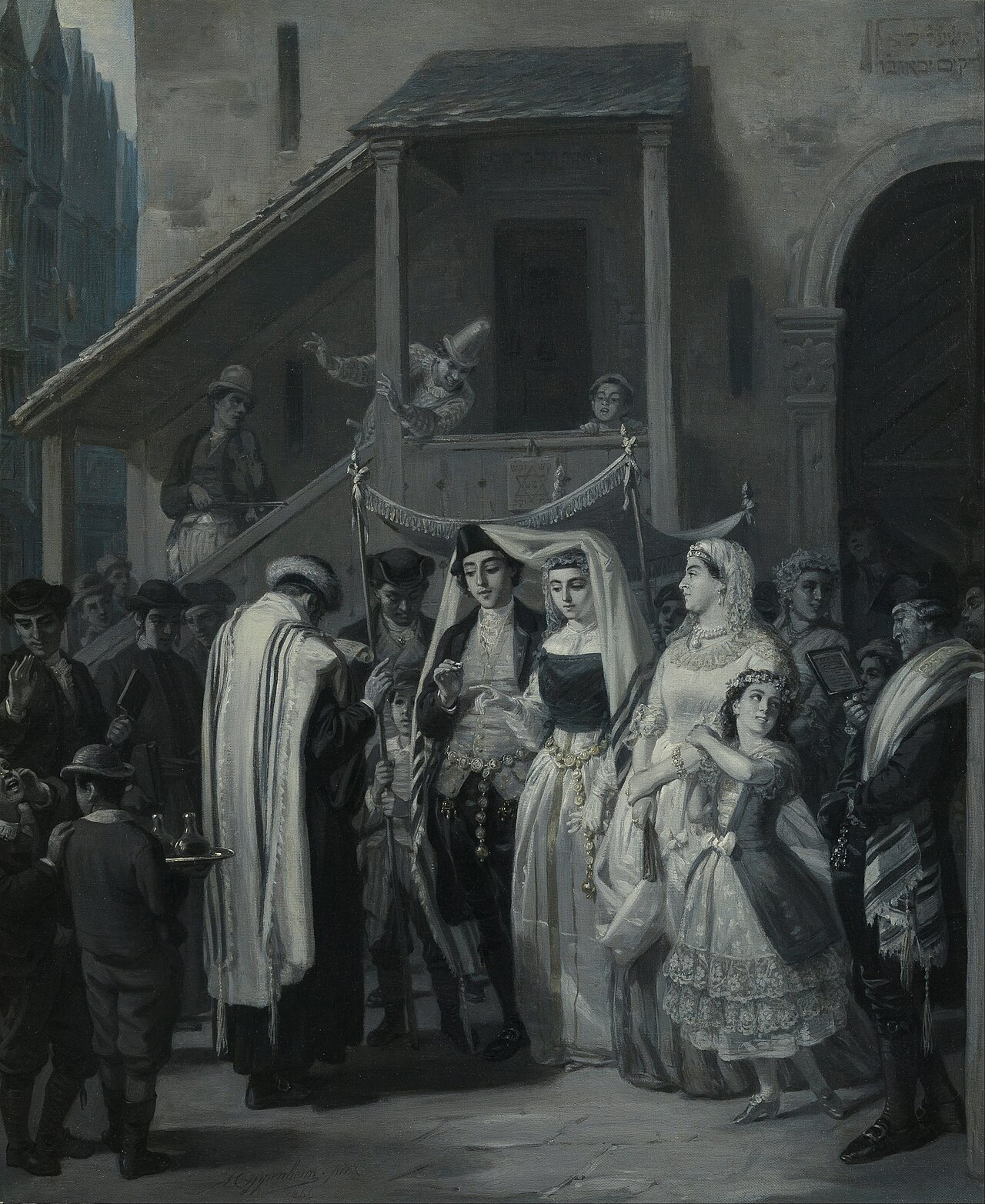
The ceremony takes place beneath the chuppah, a canopy of fabric or a prayer shawl held on four poles, sometimes by close friends or relatives. Open on all sides like the tent of Abraham, it represents the new home the couple will share. Beneath it stands a table with wine and two cups. By custom, both sets of parents walk their children down the aisle, and leading a child to the chuppah is considered one of a parent’s greatest joys; grandparents are given a place of honor in the procession.
In many traditions the bride circles the groom seven times before taking her place at his right, recalling the seven days of creation and the seven wedding blessings, and creating a circle of the new life they will share.
The Ceremony
The ketubah, a contract setting out the couple’s commitments to one another, is signed by witnesses, traditionally before the ceremony, and is often read aloud beneath the chuppah. The rabbi recites the betrothal blessing over a cup of wine, and the couple sips from it. The groom then places a ring of known value on the bride’s finger and says, in Hebrew, “Behold, you are consecrated to me with this ring according to the law of Moses and Israel.” The ring is traditionally a simple gold band, its plainness a sign of purity and true worth, placed on the right index finger and often moved to the left hand afterward.
Next come the Sheva Brachot, the seven blessings, often chanted or read by honored guests, praising God for creation, for joy and gladness, for love, harmony, peace and companionship. The couple drinks again from the cup of wine.
Mazel Tov!
At the close of the ceremony the groom, and today often the couple together, breaks a glass beneath his foot, a moment of remembrance for the destruction of the Temple in Jerusalem even at the height of joy. Then the guests burst into cheers of “Mazel tov!” and the music begins. Before joining the celebration, the newlyweds spend a few quiet minutes alone together, the yichud, their first moments as a married couple.